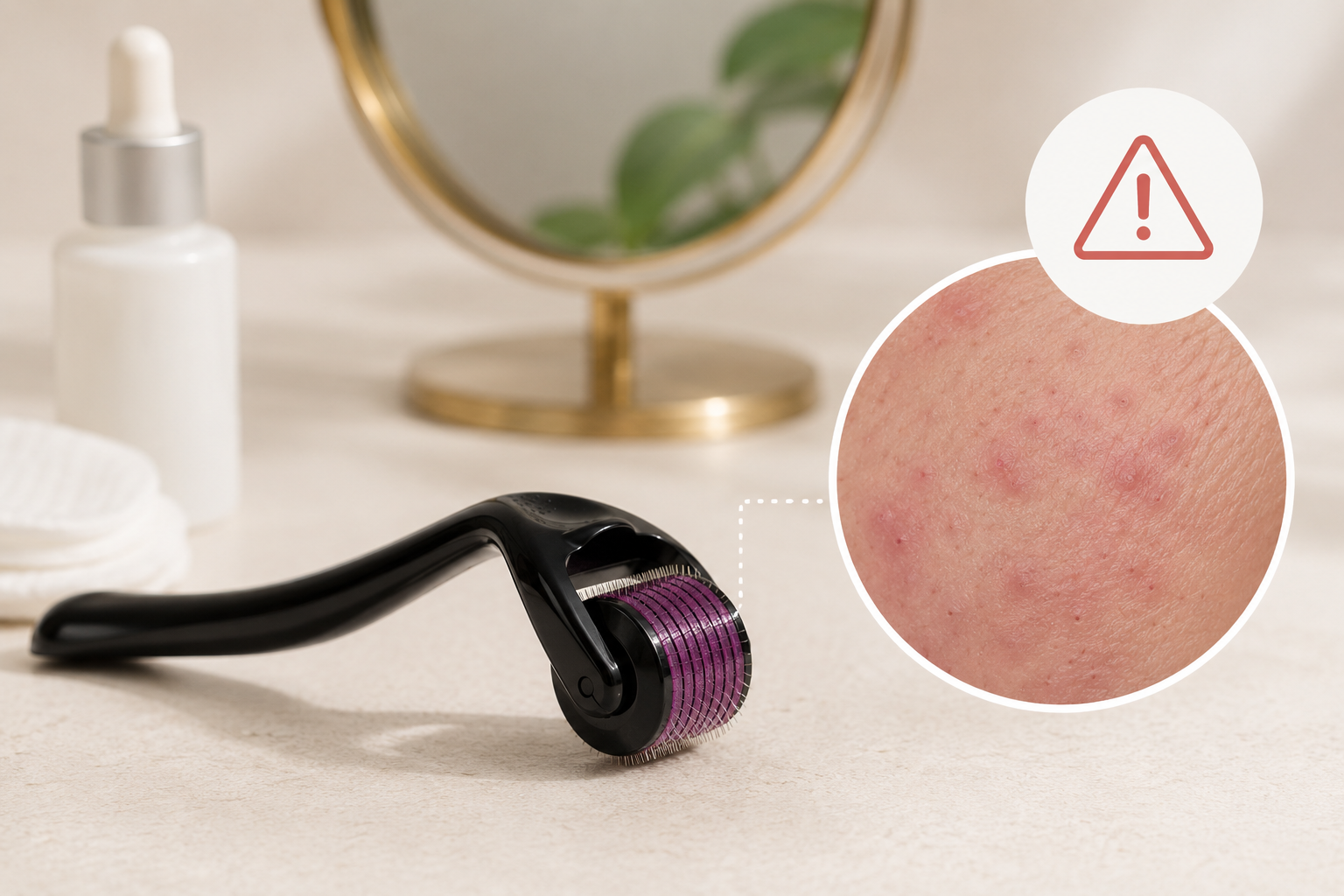
Home dermaroller: why can it do more harm than good to the skin?
On social media, the homemade dermaroller appears as a simple tool that promises smoother skin, smaller pores, reduced acne scars, and better absorption of cosmetics. With just a few swipes across the face, the skin is said to start producing collagen intensively.
In reality, however, microneedling is a much more sophisticated method. What works as a precisely controlled stimulation of regeneration in an aesthetic dermatology office can turn into uncontrolled damage to the skin barrier when used at home. The difference is not just in the needles themselves.
Microneedling is not just a simple “puncturing” of the skin
Professional microneedling is based on the creation of thousands of precisely controlled microchannels in the skin. Their depth, density and intensity are adjusted according to skin type, anatomical area and specific problem.
The goal is not to damage the skin as much as possible. On the contrary, to create exactly the right stimulus that activates the natural healing processes without disrupting its ability to regenerate properly. A home dermaroller cannot offer this control.
Uneven pressure means uneven healing
One of the biggest problems with home dermarollers is the technique itself. With each pass, the angle of the needles, the force of pressure, and the depth of penetration change. Some areas are treated several times, others almost not at all.
Instead of uniform stimulation, microtraumas of varying depths occur. The result can be prolonged redness, irritation or uneven healing of the skin. In more sensitive individuals, post-inflammatory pigmentation may also appear, which is often more difficult to treat than the original aesthetic problem.

The skin barrier needs respect
Our skin is not just an aesthetic covering for our body. It is a highly sophisticated protective barrier that protects us from bacteria, viruses, allergens and excessive water loss.
Each injection temporarily disrupts this barrier. Therefore, professional microneedling is performed under strict hygienic conditions, using sterile disposable attachments and carefully disinfecting the skin. A home environment cannot provide this level of sterility.
With each use, the dermaroller comes into contact with sebum, dead cells and bacteria, which are a natural part of the skin microbiome.
If the instrument is not thoroughly cleaned and properly disinfected, microorganisms can enter the skin during subsequent use. This can lead not only to the formation of inflammatory pimples, but also to bacterial infection or prolonged healing. This is why sterile disposable needles are used in clinics, which are safely disposed of after each treatment.
Too much pressure and worn needles – and you’ve got a problem.
A common misconception is that the more intense the treatment, the more collagen is produced. However, the biology of the skin works differently. Regeneration occurs best when stimulation is precisely controlled. Excessive damage, on the other hand, can cause long-term inflammation, disrupt the skin barrier, and slow down the natural healing process. The skin is then not firmer, but more sensitive.
Another often overlooked issue is the lifespan of the dermaroller itself. After repeated use, the needles become microscopically dull or deformed. They do not create clean microchannels, but can mechanically tear the skin. Such an injury poses a greater burden on healing and increases the risk of small scars or persistent redness.
Not every skin type is suitable for microneedling
When assessing the condition of the skin and the suitability of microneedling, it is necessary to take into account the patient’s medical history. It may not be suitable, for example, for active acne, rosacea, eczema, herpes infection or some inflammatory skin diseases. However, without a professional examination, many people do not even suspect that their skin belongs to this group. In such cases, home treatment may lead to a worsening of the condition or spread of inflammation instead of improvement.
Beware of serums applied after the dermaroller
With home microneedling, it is often recommended to apply various active serums immediately after treatment. However, substances that are safe on the surface of the skin may not be suitable when they penetrate the damaged skin barrier into deeper layers.
Perfumes, preservatives or some active ingredients can cause significant irritation or an allergic reaction. Therefore, only products intended for application after microneedling are used in professional treatments.
Modern aesthetic dermatology is one step further today
A few years ago, microneedling was based primarily on mechanical stimulation of the skin using microneedles. Today, however, modern aesthetic dermatology uses technologies that can work with regeneration much more effectively.
One of them is the Morpheus8 microneedle radiofrequency.
Unlike a classic dermaroller, it does not only create controlled microchannels. The gold-plated microneedles simultaneously deliver radiofrequency energy to a precisely selected depth of the skin and subcutaneous tissue, where a controlled thermal effect is created.
It is the combination of mechanical stimulation and radiofrequency energy that supports collagen remodeling, elastin formation, and the renewal of deeper layers of tissue. So it’s not just about the injection itself. It’s about precisely controlled biological stimulation that a home dermaroller simply cannot offer.
Thanks to the ability to individually adjust the depth of the needles and the intensity of the radiofrequency energy, the treatment can be tailored to the specific needs of the skin – from fine wrinkles to enlarged pores and acne scars to firming the contours of the face, chin or other parts of the body. The result is smoothing of the skin, improving its quality and increasing its firmness and elasticity. The skin thus appears healthier and younger.
Beautiful skin doesn’t come from major damage
Successful skin regeneration is not a matter of the greatest number of injections or the strongest pressure. It is the result of precisely controlled stimulation that respects the biology of the skin and supports its natural healing processes.
This is the biggest difference between a home dermaroller and modern dermatological technologies. While home devices work primarily mechanically, professional treatments use the knowledge of regenerative medicine and advanced technologies to stimulate the skin more safely, effectively, and with more predictable results.
When it comes to skin health and quality, it’s not enough to just create punctures. It’s important to know how deep, how intensely, and why. Otherwise, you risk infection, scarring, and subsequent pigmentation.
You might also be interested in

What are the facelift methods? Differences between mini facelift, SMAS and Deep Plane facelift
Facelift is one of the most effective surgical methods of facial rejuvenation. However, individual techniques differ significantly not only in the scope of the operation, but also in the anatomical layers they work with and the results they are able to achieve. The fundamental difference is not just the size of the incision or the … Continued
Read more
Why our eyes are often the first to reveal our age
Lots of energy, but your eyes look tired. Often it’s not a lack of sleep, a difficult period or stress. A person may feel full of energy, active and happy, but their eyes may be sending a different signal. The area around the eyes is one of the first places on the face to show changes related to age, genetics, … Continued
Read more
How long does a facelift last?
Find out how long a facelift lasts, what affects its durability, and how you can maintain the results of your rejuvenation for as long as possible.
Read more